


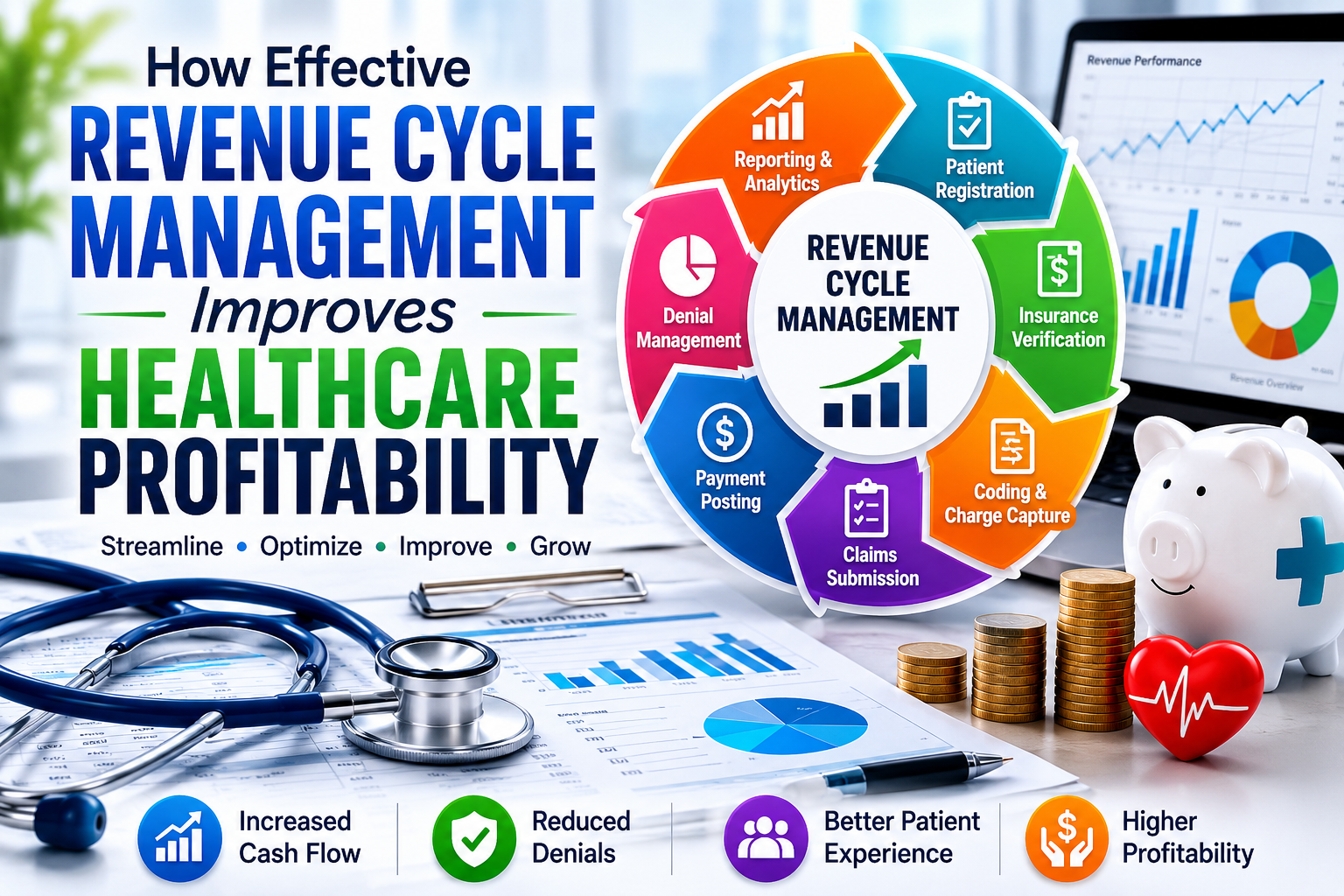

How Effective Revenue Cycle Management Improves Healthcare Profitability
Introduction
In today’s complex healthcare environment, financial stability is just as important as delivering quality patient care. Healthcare providers face increasing challenges, including changing payer regulations, rising operational costs, staffing shortages, and growing administrative workloads. To remain financially healthy while focusing on patient outcomes, organizations must optimize every aspect of their revenue cycle.
Revenue Cycle Management (RCM) is the backbone of healthcare financial operations. It encompasses every step involved in managing patient revenue—from appointment scheduling and insurance verification to claim submission, payment posting, denial management, and final reimbursement collection. An efficient RCM process helps healthcare organizations improve cash flow, reduce claim denials, and maximize revenue.
What is Revenue Cycle Management?
Revenue Cycle Management is the process of tracking patient care episodes from registration and appointment scheduling through the final payment of balances. It integrates administrative and clinical functions to ensure healthcare providers receive accurate and timely reimbursement for services rendered.
The key stages of RCM include:
- Patient Registration
- Insurance Eligibility Verification
- Prior Authorization
- Medical Coding
- Charge Entry
- Claims Submission
- Payment Posting
- Accounts Receivable Follow-Up
- Denial Management
- Patient Billing and Collections
Each stage plays a vital role in ensuring revenue is captured efficiently and accurately.
How Effective RCM Improves Healthcare Profitability
1. Reduces Claim Denials
Claim denials are among the most significant causes of revenue loss in healthcare organizations. Errors such as incorrect patient information, coding mistakes, missing documentation, or authorization issues can result in denied claims.
An effective RCM strategy helps identify potential issues before claims are submitted, reducing denial rates and increasing first-pass claim acceptance.
Benefits:
- Fewer rejected claims
- Faster reimbursements
- Reduced rework and administrative costs
- Improved revenue recovery
2. Accelerates Cash Flow
Delayed payments can create financial strain for healthcare organizations. Efficient revenue cycle processes ensure claims are submitted promptly and followed up consistently.
By reducing claim processing times and resolving outstanding accounts quickly, providers can receive payments faster and maintain healthy cash flow.
Benefits:
- Improved liquidity
- Faster reimbursement cycles
- Better financial planning
- Increased operational stability
3. Enhances Billing Accuracy
Accurate medical billing is essential for proper reimbursement. Effective RCM includes thorough verification of patient information, correct coding practices, and detailed claim reviews.
Accurate billing minimizes payment delays and helps healthcare providers receive the full reimbursement they are entitled to.
Benefits:
- Reduced billing errors
- Higher reimbursement rates
- Increased compliance
- Better patient trust
4. Improves Accounts Receivable Performance
Outstanding accounts receivable can negatively impact financial performance. Regular monitoring and proactive follow-up help recover unpaid claims and prevent aging accounts from becoming bad debt.
Professional RCM teams track claims closely and work with insurance companies to resolve payment issues quickly.
Benefits:
- Lower AR days
- Increased collections
- Reduced write-offs
- Improved revenue recovery
5. Strengthens Compliance and Risk Management
Healthcare organizations must comply with various payer regulations, coding standards, and privacy requirements. Failure to comply can result in penalties, audits, and revenue loss.
A structured RCM process helps maintain compliance with healthcare industry standards and payer guidelines while reducing operational risks.
Benefits:
- Reduced compliance risks
- Better documentation accuracy
- Increased audit readiness
- Enhanced operational integrity
6. Improves Patient Experience
Patients today expect transparency and accuracy in healthcare billing. Confusing bills, insurance disputes, and payment delays can negatively impact patient satisfaction.
An efficient revenue cycle provides clear communication, accurate billing, and streamlined payment processes.
Benefits:
- Improved patient satisfaction
- Increased trust and loyalty
- Better payment collection rates
- Enhanced provider reputation
7. Supports Business Growth
As healthcare organizations expand, revenue cycle complexity increases. A scalable RCM process ensures providers can manage growing patient volumes without compromising financial performance.
Professional RCM services provide the expertise and resources needed to support long-term growth.
Benefits:
- Sustainable business expansion
- Improved operational efficiency
- Greater profitability
- Better resource allocation
Key Metrics Improved by Effective RCM
Healthcare organizations implementing strong revenue cycle management often see improvements in:
- First-Pass Claim Acceptance Rate
- Days in Accounts Receivable (AR)
- Net Collection Rate
- Denial Rate
- Clean Claim Rate
- Cash Flow Performance
- Patient Payment Collections
- Overall Revenue Growth
Monitoring these metrics helps providers evaluate financial performance and identify opportunities for improvement.
Why Outsource Revenue Cycle Management?
Many healthcare providers choose to outsource RCM functions to experienced specialists who understand payer requirements, industry regulations, and reimbursement processes.
Outsourcing offers several advantages:
- Access to experienced RCM professionals
- Reduced operational costs
- Improved billing accuracy
- Faster claim processing
- Enhanced reporting and analytics
- Better denial management
- Increased reimbursement rates
By partnering with a trusted RCM provider, healthcare organizations can focus on delivering exceptional patient care while experts manage the revenue cycle.
Conclusion
Revenue Cycle Management is more than an administrative function—it is a critical component of healthcare profitability and operational success. From reducing claim denials and accelerating cash flow to improving compliance and patient satisfaction, effective RCM directly impacts an organization’s financial health.
Healthcare providers that invest in optimized revenue cycle processes are better positioned to maximize reimbursements, improve operational efficiency, and achieve sustainable growth. In an increasingly competitive healthcare landscape, strong Revenue Cycle Management is essential for long-term success.
At Korvexa Healthcare Solutions, we help healthcare providers streamline revenue cycle operations, reduce denials, improve collections, and maximize profitability through reliable and efficient RCM solutions.




A WordPress Commenter
June 17, 2026Hi, this is a comment.
To get started with moderating, editing, and deleting comments, please visit the Comments screen in the dashboard.
Commenter avatars come from Gravatar.