


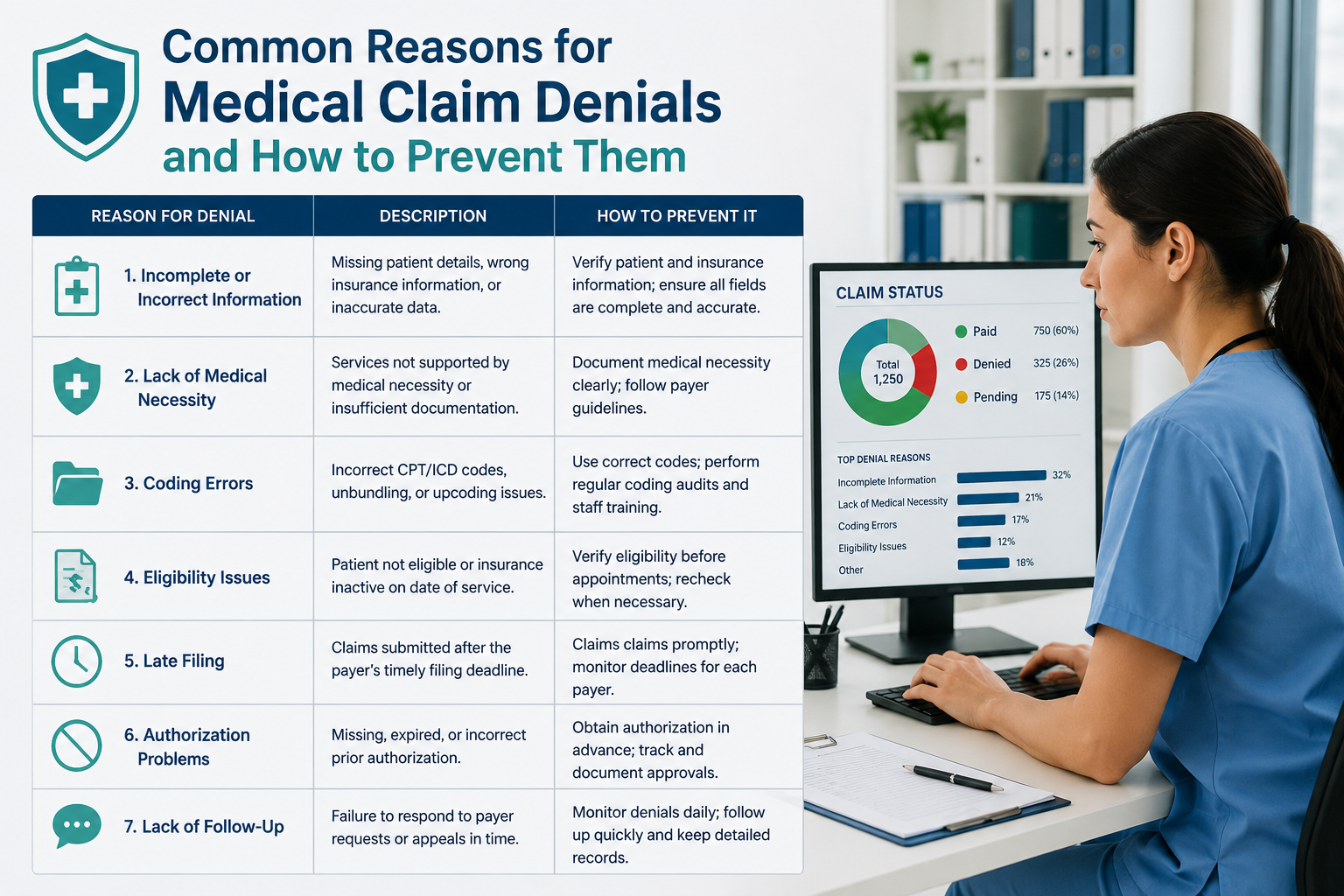

Common Reasons for Medical Claim Denials and How to Prevent Them
Introduction
Medical claim denials are one of the most significant challenges healthcare providers face in managing their revenue cycle. Every denied claim represents delayed revenue, increased administrative workload, and additional costs associated with rework and appeals. Even a small increase in denial rates can have a substantial impact on a healthcare organization’s financial performance.
According to industry estimates, a significant percentage of denied claims are preventable when proper processes, technology, and quality controls are in place. Understanding the root causes of denials and implementing proactive prevention strategies can help healthcare providers improve reimbursement rates, reduce administrative burdens, and strengthen cash flow.
In this blog, we explore the most common reasons for medical claim denials and practical strategies to prevent them.
What is a Medical Claim Denial?
A medical claim denial occurs when an insurance payer refuses to reimburse a healthcare provider for services rendered. Denials may be temporary and correctable or permanent depending on the nature of the issue.
When claims are denied, providers must investigate the reason, correct any errors, submit appeals when appropriate, and follow up with payers to recover revenue. This process consumes valuable time and resources that could otherwise be focused on patient care and operational improvement.
The Financial Impact of Claim Denials
Claim denials can create serious financial challenges for healthcare organizations, including:
- Delayed reimbursements
- Increased administrative costs
- Higher accounts receivable balances
- Lost revenue opportunities
- Reduced operational efficiency
- Increased staff workload
- Lower profitability
A strong denial management program helps healthcare providers minimize these risks and improve overall financial performance.
Common Reasons for Medical Claim Denials
1. Inaccurate Patient Information
One of the most common causes of claim denials is incorrect or incomplete patient information. Errors in names, dates of birth, policy numbers, insurance details, or demographic data can result in claim rejection.
Common Errors:
- Incorrect patient identification
- Misspelled names
- Invalid insurance policy numbers
- Incorrect date of birth
- Missing demographic information
Prevention Strategies:
- Verify patient information during every visit.
- Update records regularly.
- Use automated verification tools.
- Train front-desk staff on accurate data collection procedures.
2. Insurance Eligibility Issues
Claims are frequently denied when a patient’s insurance coverage is inactive, expired, or does not cover the services provided.
Common Causes:
- Expired insurance coverage
- Inactive policies
- Coverage limitations
- Out-of-network services
Prevention Strategies:
- Conduct eligibility verification before appointments.
- Confirm benefits and coverage details.
- Verify network participation.
- Recheck eligibility for recurring patients.
3. Lack of Prior Authorization
Many healthcare services require prior authorization from insurance providers before treatment can be delivered. Failure to obtain authorization can result in claim denials.
Common Causes:
- Authorization not obtained
- Authorization expired
- Incorrect authorization details
- Services exceeding approved limits
Prevention Strategies:
- Maintain authorization tracking systems.
- Submit requests well in advance.
- Monitor authorization expiration dates.
- Verify approved service details before treatment.
4. Medical Coding Errors
Accurate coding is critical for successful claim processing. Coding mistakes can lead to denials, underpayments, or compliance concerns.
Common Coding Errors:
- Incorrect CPT codes
- Invalid ICD-10 codes
- Missing modifiers
- Unbundling services
- Upcoding or downcoding
Prevention Strategies:
- Provide ongoing coding education.
- Conduct regular coding audits.
- Utilize certified medical coders.
- Implement coding quality assurance reviews.
5. Missing or Incomplete Documentation
Insurance payers require sufficient documentation to support medical necessity and services rendered. Missing documentation often results in claim denials.
Common Documentation Issues:
- Incomplete medical records
- Missing physician notes
- Lack of supporting evidence
- Missing signatures
Prevention Strategies:
- Standardize documentation processes.
- Train providers on documentation requirements.
- Conduct routine chart reviews.
- Use electronic health record (EHR) systems effectively.
6. Timely Filing Limit Exceeded
Insurance companies establish deadlines for claim submission. Claims submitted after these deadlines are typically denied.
Common Causes:
- Delayed claim submission
- Administrative backlogs
- Incomplete patient information delaying processing
Prevention Strategies:
- Submit claims promptly.
- Monitor filing deadlines.
- Automate claim tracking.
- Establish workflow alerts for pending claims.
7. Duplicate Claim Submission
Submitting the same claim multiple times can trigger automatic denials from insurance payers.
Common Causes:
- Lack of claim tracking
- System processing delays
- Manual resubmission errors
Prevention Strategies:
- Track claim status carefully.
- Confirm payer processing before resubmission.
- Utilize claim management software.
- Implement duplicate claim detection procedures.
8. Non-Covered Services
Insurance plans do not cover all procedures or treatments. Claims may be denied if the service falls outside the patient’s benefits.
Common Causes:
- Excluded services
- Benefit limitations
- Cosmetic procedures not covered
- Experimental treatments
Prevention Strategies:
- Verify benefits before treatment.
- Inform patients about coverage limitations.
- Obtain signed financial responsibility agreements.
- Document medical necessity thoroughly.
9. Coordination of Benefits (COB) Issues
Patients with multiple insurance plans may experience claim denials when coordination of benefits information is incomplete or inaccurate.
Common Causes:
- Missing secondary insurance information
- Incorrect payer order
- Outdated COB records
Prevention Strategies:
- Verify all active insurance plans.
- Update COB information regularly.
- Confirm primary and secondary payer responsibilities.
10. Authorization and Referral Errors
Some insurance plans require referrals from primary care physicians or specific authorization procedures before treatment.
Common Causes:
- Missing referrals
- Expired referrals
- Incorrect referral information
Prevention Strategies:
- Verify referral requirements before appointments.
- Maintain referral tracking systems.
- Communicate requirements clearly to patients.
How Effective Denial Management Reduces Revenue Loss
A proactive denial management strategy focuses on identifying, analyzing, correcting, and preventing denials.
Key denial management activities include:
Root Cause Analysis
Identify recurring denial trends and underlying causes.
Appeal Management
Prepare detailed appeals with supporting documentation to recover denied revenue.
Staff Training
Educate billing, coding, and registration teams on payer requirements and best practices.
Performance Monitoring
Track denial rates, payer trends, and key performance indicators.
Process Improvement
Implement workflow enhancements to reduce future denials.
The Role of Technology in Denial Prevention
Modern healthcare organizations increasingly use technology to reduce claim denials.
Benefits of Technology:
- Automated eligibility verification
- Real-time claim scrubbing
- Coding assistance tools
- Denial trend reporting
- Workflow automation
- Revenue cycle analytics
Technology helps identify issues before claims are submitted, significantly improving first-pass acceptance rates.
Key Metrics to Monitor
Healthcare providers should regularly track:
- Claim Denial Rate
- First-Pass Acceptance Rate
- Net Collection Rate
- Days in Accounts Receivable
- Appeal Success Rate
- Denial Recovery Rate
- Revenue Leakage Indicators
Monitoring these metrics helps organizations identify improvement opportunities and measure the effectiveness of denial prevention efforts.
Conclusion
Medical claim denials can have a significant impact on healthcare revenue, cash flow, and operational efficiency. However, many denials are preventable through accurate patient registration, insurance verification, proper documentation, coding accuracy, timely claim submission, and proactive denial management.
By identifying the root causes of denials and implementing effective prevention strategies, healthcare providers can improve claim acceptance rates, accelerate reimbursements, reduce administrative costs, and maximize profitability.
At Korvexa Healthcare Solutions, our experienced Revenue Cycle Management specialists help healthcare organizations reduce denials, recover lost revenue, improve collections, and achieve stronger financial performance through comprehensive denial management solutions.



Hola Kala
January 28, 2024when an unknown printer took a galley of type and scrambled it to make a type specimen bookhas a not only five centuries, but also the leap into electronic typesetting, remaining essentially unchan galley of type and scrambled it to make a type specimen book.